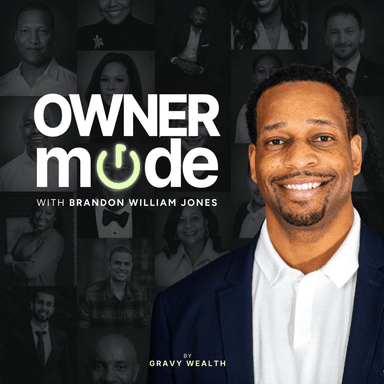
The Podcast
Most people earn. A few own.
Owner Mode is the show for ambitious professionals ready to make the shift.
Hosted by Brandon William Jones, founder and CEO of Gravy Wealth. Each episode reveals how founders, investors, operators, and acquisition entrepreneurs built ownership, wealth, and freedom beyond their careers.
The playbooks are rarely public. The conversations usually happen behind closed doors. Welcome to Owner Mode.


The Hidden Playbook | Will Drewery
Will Drewery managed about $3.5 billion in equipment spend at Tesla before he left to build his own company. When he founded Diagon, he launched it on a playbook most founders never get told: do not pay full price for anything in year one. In this Owner Mode conversation, Will breaks down the mechanics nobody advertises. Law firms that believe you are headed for venture funding will defer their fees until you raise. VC firms will pay you a contractor wage to incubate an idea through an entrepreneur-in-residence program. Your own bootstrap cash can go in as a promissory note you can recover later instead of money you simply spend. He also walks through how a venture call is actually structured, why he weights a founder's network far above the idea itself, and the tax moves that decide how much of the upside you keep, including the 83(b) election he filed on four million shares for $40 and the QSBS exclusion that can make up to $10 million of gain tax-free. He is clear-eyed about the limits, too. None of the deferrals are free money, and the programs depend on a firm believing you are genuinely venture-track. This is a straight look at how a senior operator launches without burning his savings, and why he thinks the cost of building has never been lower. Chapters: 00:00 A playbook nobody advertises 00:54 Brandon introduces Will Drewery 00:56 From Baghdad to an early seat at Tesla 00:58 Managing $3.5B in spend, and the bonus that woke him up 01:01 The belief: founders should not pay full price in year one 01:03 Getting paid to build: the entrepreneur-in-residence path 01:08 Deferred billing: how firms carry a pre-funded founder 01:10 The promissory note: bootstrap cash you can get back 01:14 How a venture call is actually structured 01:24 83(b) and QSBS: keeping the value you create 01:31 A working MVP in 45 minutes 01:35 The game is rigged, and why now is the moment Links: Book Will Drewery 1-on-1: gravywealth.com/expert/willdrewery Explore the Launch pathway: gravywealth.com/launch Full transcript: gravywealth.com/podcast/will-drewery-hidden-playbook/transcript Owner Mode Memo: gravywealth.com/memo Owner Mode podcast: gravywealth.com/podcast DNA Assessment: go.gravywealth.com/DNA Disclaimer: This content is for educational and informational purposes only and reflects the personal experiences and opinions of the participants. Nothing here is investment, legal, tax, or financial advice, or a recommendation to buy or sell any security. Past results do not guarantee future outcomes. Do your own research and consult your own professional advisors before making any financial decision.
What Makes Operators Board-Ready | Robin Washington
Robin Washington sits on the boards of Alphabet and Honeywell and serves as President, COO, and CFO of Salesforce. Her first board seat came before she was even a CFO. In this Owner Mode conversation, she explains the one thing she says makes anyone board ready: being genuinely exceptional at your day job, because the board members and leadership team around you are the ones who notice. She describes writing "join a Fortune 500 public board" into her performance appraisal as a sitting CFO, telling the board members she knew, and how her seats followed, one through a recruiting firm and one from Mark Benioff after years of knowing each other. She also covers what a board member actually does and why great operators can struggle with it, what her first boardroom was like as the only woman in the room, the reputation risk that comes with every seat, and the question she asked Sundar Pichai before joining Alphabet: why do you want me on this board? Chapters: 00:00 The one thing that makes you board ready 00:30 Why a board director stepped in to run the company 07:13 From finance to a first board seat before CFO 14:20 You are not an operator as a board member 16:56 The only woman in her first boardroom 21:00 Getting noticed and putting the goal in writing 29:44 The reputation risk that comes with every seat 33:46 Why do you want me on this board? Links: Explore the Advise pathway: gravywealth.com/advise Full transcript: gravywealth.com/podcast/robin-washington-what-makes-operators-board-ready/transcript Owner Mode Memo: gravywealth.com/memo Owner Mode podcast: gravywealth.com/podcast DNA Assessment: go.gravywealth.com/DNA Disclaimer: This content is for educational and informational purposes only and reflects the personal experiences and opinions of the participants. Nothing here is investment, legal, tax, or financial advice, or a recommendation to buy or sell any security. Past results do not guarantee future outcomes. Do your own research and consult your own professional advisors before making any financial decision.
The Patient Owner | Mellody Hobson (Ariel Investments)
Mellody Hobson has been investing for 35 years. She is Co-CEO of Ariel Investments, one of the most respected active-management firms in America, a Board Director at JPMorgan Chase, and former Chair of both Starbucks Corporation and DreamWorks Animation. In this Owner Mode conversation, she makes the case for patience as the real edge in private markets. Asked what high earners get wrong, she leads with the trade-off rather than the upside: private markets cost you liquidity, and you cannot simply change your mind and sell. From there she lays out a clear sequence. Build a diversified public portfolio first. Treat private markets as the add-on, not the anchor. Find a financial adviser who syndicates access. Then accept the illiquidity and hold. She also walks through the Ariel thesis of investing in what is misunderstood, ignored, and under-followed, and applies it to women's sports, which she calls the small caps of sports. She names the access reality without hedging, including her own fund's $5 million minimum. The throughline is the line she keeps returning to: it's the time in the market, not timing the market that leads to long term success. Her closing instruction is the one to keep: if you are going to be an owner, be a patient owner. This is a clear, experienced look at how to enter private markets the right way, from someone who has spent three and a half decades inside the room. Chapters: 00:09:24 Introduction: Mellody Hobson and the Ariel approach 00:13:18 Investing in the misunderstood, ignored, and under-followed 00:13:22 Women's sports as the small caps of sports 00:14:45 The honest access conversation: the $5 million minimum 00:17:54 Democratizing access to long-term wealth 00:22:02 Time in the market, not timing the market 00:23:13 How to enter private markets: an add-on, not an anchor 00:26:15 AI and what stays valuable for knowledge workers 00:29:05 The information diet: four papers and "buy reading glasses" 00:34:35 If you're gonna be an owner, be a patient owner Links: Foundation: gravywealth.com/foundation Full transcript: gravywealth.com/podcast/mellody-hobson-patient-owner/transcript Owner Mode Memo: gravywealth.com/memo Owner Mode podcast: gravywealth.com/podcast DNA Assessment: go.gravywealth.com/DNA Disclaimer: This content is for educational and informational purposes only and reflects the personal experiences and opinions of the participants. Nothing here is investment, legal, tax, or financial advice, or a solicitation to buy or sell any security. Investing in private securities involves significant risk, including possible loss of principal, and past performance does not guarantee future results. Do your own research and consult your own professional advisors before making any investment decision.
Playing Chess | Ashley Flucas (Flucas Ventures)
Ashley Flucas is COO of Summit Ventures and founder of Flucas Ventures, one of the most active venture capital syndicates in the world, with 250+ investments including Databricks, Brex, and Mercury. She is a former capital markets attorney who left law to build all of it. In this Owner Mode conversation, Ashley traces how she went from Harvard Law and capital markets law to one of the most active syndicates in the country. She came back to Florida in 2018 with no tech network, taught herself by writing small checks into deals she could afford to be wrong about, and treated the reps as the education. Her warning: if you just keep studying, you will get analysis paralysis. Within two years she launched her own first SPV, Andreessen Horowitz invested alongside her, and the New York Times profiled her. She also breaks down the structure underneath the returns. She runs a barbell, venture for upside on one side, income and real estate for stability and tax treatment on the other. She explains how QSBS works on the venture side, how she chose an operating role that unlocked real estate depreciation, and why she moved her domicile to Florida. Her effective rate now runs in the mid-teens, the result of career design rather than a loophole. She closes on risk, and her framing is the one to sit with. The bigger regret, in her view, is never taking the swing, as long as you have built the structure to survive the worst case first. This is a specific, candid look at how a high earner builds private-market ownership through action and structure rather than analysis, and why what you keep matters as much as what you make. Chapters: 00:00 Own assets or get left behind 00:30 Brandon introduces Ashley Flucas 02:00 Duke, Harvard Law, and the box of career paths she thought existed 06:00 The book that reframed everything: The Monk and the Riddle 10:00 Florida, no tech network, and learning by doing 14:00 AngelList and the entry ladder into syndication 18:00 The barbell: venture on one side, real estate and income on the other 24:00 Golden handcuffs, autonomy, and the number that keeps moving 27:00 Tax structure: QSBS, depreciation, and Florida domicile 33:00 How to evaluate a syndicate and pick your first deals 40:00 What she is investing in now: AI infrastructure, aerospace and defense 44:00 The family office north star and the risk math 46:00 Closing: own assets or be left behind Links: Foundation: gravywealth.com/foundation Full transcript: gravywealth.com/podcast/ashley-flucas-playing-chess/transcript Owner Mode Memo: gravywealth.com/memo Owner Mode podcast: gravywealth.com/podcast DNA Assessment: go.gravywealth.com/DNA Disclaimer: This content is for educational and informational purposes only and reflects the personal experiences and opinions of the participants. Nothing here is investment, legal, tax, or financial advice, or a solicitation to buy or sell any security. Investing in private securities involves significant risk, including possible loss of principal, and past performance does not guarantee future results. Do your own research and consult your own professional advisors before making any investment decision.
The Private Markets Playbook | Ryan Williams of Cadre
Ryan Williams founded Cadre, a $5B+ real estate investment platform, at twenty-five, after stints at Goldman Sachs and Blackstone. He built it to do something those firms never did: put Harvard's endowment, BlackRock, and the Ford Foundation into the same institutional-quality deals as individual investors. In this Owner Mode conversation, Ryan traces the whole arc. As a Harvard sophomore during the 2008 crisis, he saw a pricing dislocation in Atlanta, pooled money from classmates, and bought a house on New Hope Road for $63,000, making 3x unlevered before he graduated. By his first year at Goldman he owned nearly 1,000 residential units, run on nights and weekends. What he could not unsee at the institutional shops was that the best private real estate deals reached only a tiny group of investors when the economics could have supported individuals. The gatekeeping was structural, not mathematical. So he built the door. The principle underneath it all is trust. "Nothing compounds faster than trust. Not capital. Not talent. Not credentials." The first dollars in are trust dollars, and the way to compress that curve is to be the institutional version of yourself before you have institutional reasons to be. Ryan closes with why private markets are structurally less efficient and therefore richer in opportunity, and a three-question framework for allocating to illiquid assets. Chapters: 02:36:49 Introduction: Goldman TMT, Blackstone real estate PE, founding Cadre at 25 02:41:39 The dorm-room thesis: what would have to be true for this not to work 02:43:55 First deal on New Hope Road: $63K in, 3x unlevered, junior year 02:46:42 Goldman by day, Atlanta real estate by night: nearly 1,000 units 02:59:51 The thing he could not unsee: the best deals reaching a tiny group 03:02:35 Nothing compounds faster than trust: the trust dollars framework 03:13:30 The case for private markets: structurally less efficient, more alpha 03:32:52 How to start: don't start with a deal, start with a thesis Links: Foundation: gravywealth.com/foundation Full transcript: gravywealth.com/podcast/ryan-williams-private-markets-playbook/transcript Owner Mode Memo: gravywealth.com/memo Owner Mode podcast: gravywealth.com/podcast DNA Assessment: go.gravywealth.com/DNA Disclaimer: This content is for educational and informational purposes only and reflects the personal experiences and opinions of the participants. Nothing here is investment, legal, tax, or financial advice, or a solicitation to buy or sell any security. Investing in private securities involves significant risk, including possible loss of principal, and past performance does not guarantee future results. Do your own research and consult your own professional advisors before making any investment decision.
From Framework to Funding | Marlon Nichols & Bonita Stewart
Marlon Nichols and Bonita Stewart join the Owner Mode Summit to compare how a VC and an operator evaluate the same early-stage company. Marlon is Managing General Partner at MaC Venture Capital, with over $600M in AUM, 238 portfolio companies, and five IPOs. Bonita is Co-founder and Managing Partner of BAG Ventures and a co-lead of the BAG Collective, a 400+ angel investor community, and was the first Black woman VP at Google. Marlon explains his second-order effects thesis: rather than investing in AI itself, he invests in what AI breaks and rebuilds downstream, across energy, the physical world, and specific industries. He lays out his four nonnegotiables for any team he backs: someone who understands the technology, a founder who pulls talent, a product person who can ship, and the ability to sell. He has tried to proceed with three of the four, and it never works. Bonita brings the operator's lens to investing. She sends venture partners to look at a startup's code before BAG writes a check, screening for a real technology moat, and adds strategic resilience as a filter for founders who can absorb a setback and pivot at the right moment. For high earners entering private markets, both deliver the same message: have a thesis before you write a check, invest in what you understand, and stay away from hype cycles. This is a practical look at how professional investors actually evaluate early-stage companies before any money moves, recorded as the fireside that opened the Summit's $100K pitch competition. Chapters: 01:01:54 Introductions: Bonita Stewart and Marlon Nichols 01:05:40 Marlon's thesis: from cultural investing to second-order effects 01:11:46 Everything starts with team: Marlon's four nonnegotiables 01:19:14 Table stakes before the conversation: market, competition, unfair advantage 01:23:07 Bonita's AI filter: go under the hood and vet the tech 01:24:01 Strategic resilience: can the founder pivot at the right moment 01:32:24 Advice for high earners deploying their first six figures 01:34:31 Have a thesis before you write a check Links: Foundation: gravywealth.com/foundation Full transcript: gravywealth.com/podcast/marlon-bonita-panel-framework-to-funding/transcript Owner Mode Memo: gravywealth.com/memo Owner Mode podcast: gravywealth.com/podcast DNA Assessment: go.gravywealth.com/DNA Disclaimer: This content is for educational and informational purposes only and reflects the personal experiences and opinions of the participants. Nothing here is investment, legal, tax, or financial advice, or a solicitation to buy or sell any security. Investing in private securities involves significant risk, including possible loss of principal, and past performance does not guarantee future results. Do your own research and consult your own professional advisors before making any investment decision.
Building Your Board Portfolio | Stacy Brown-Philpot
Stacy Brown-Philpot joined Google when it had roughly a thousand employees and was there as it grew to fifty thousand. She went on to run TaskRabbit as COO and then CEO, leading the company through its acquisition by IKEA. And while she was operating, she built a public-company board portfolio that included HP, Nordstrom, StockX, and Noom. In this Owner Mode conversation, Stacy lays out the exact playbook she ran before any board opportunity existed. She explains the difference between a resume and a board bio, why she seeded her name proactively with directors and recruiters, and why a mentor told her to aim for the biggest public company first. She breaks down how she used HP's published skills matrix to know precisely which gap she could fill, and the advice that shaped her interview: stay in your lane. She is direct about the cost and the payoff, including the phone interview she stopped when her youngest was crying, certain she had lost the seat, and what the board member told her instead. She also covers portfolio construction, the ten-year commitment reality, and the financial mechanics of public versus private boards. Stacy is now Founder and Managing Partner of Cherryrock Capital, the first Black woman-founded, multi-hundred-million-dollar venture firm focused on Black and Latine founders. This is a tactical, honest guide to board service as an ownership pathway. Chapters: 00:00 My baby's crying, I can't finish this interview 00:02 Brandon introduces Stacy and the phase-four bet 00:08 Detroit, Wharton, Goldman, and the road to Google 00:11 "I got lonely": founding the Black Googler Network 00:24 How global operating built her board-candidate profile 00:29 Discovering boards as the level above the C-suite 00:31 The board-entry playbook: bio, seeding the message, the skills matrix 00:40 Aim for a big public company first: the HP opening 00:45 "Stay in your lane": the interview advice from Ken Coleman 00:48 The Zuri call, and what the board member actually said 01:01 Two public boards plus CEO plus two kids: the honest cost 01:21 Phase four: Cherryrock Capital and completing the VC chapter Links: Explore the Advise pathway: gravywealth.com/advise Full transcript: gravywealth.com/podcast/stacy-brown-philpot-building-your-board-portfolio/transcript Owner Mode Memo: gravywealth.com/memo Owner Mode podcast: gravywealth.com/podcast DNA Assessment: go.gravywealth.com/DNA Disclaimer: This content is for educational and informational purposes only and reflects the personal experiences and opinions of the participants. Nothing here is investment, legal, tax, or financial advice, or a recommendation to buy or sell any security. Past results do not guarantee future outcomes. Do your own research and consult your own professional advisors before making any financial decision.
Assets Over Hours: Replace Your Paycheck | Arthur Johnson
Arthur Johnson spent his career in senior strategy roles at Goldman Sachs, Cisco, Twilio, and Pure Storage. He also quietly built a 50+ unit rental portfolio across Texas, Indiana, and Wisconsin, and used it to leave corporate at 52. In this Owner Mode conversation, he traces how a tech executive bought his way out one property at a time, without ever quitting his job. The turning point was a desk at HP at nine at night, far from his family, where he felt like a small cog in a big wheel and decided that was not how he wanted to spend the rest of his career. Instead of a dramatic exit, he built a second engine on nights and weekends. He explains how he scored the top 300 metros to choose his markets, why he set a 15% cash-on-cash floor and walked past anything below it, and how he financed a growing portfolio three different ways as it scaled. He goes deep on the two moves that made it work alongside a career. The first is operational: an operating system he calls manage the manager, which applied his corporate management skills to his property managers through weekly check-ins, clear performance goals, and a protocol for anything off-plan. The second is the tax strategy that took his federal rate from 35% to as low as 10% using real estate professional status and cost segregation. He is honest about what is conditional, including the household requirement behind the tax piece. The close is the part most people skip past. Arthur admits he was so deep in his career that he almost lost himself in it, and that the real work was separating his identity from his title before he could build a next chapter that was actually his. This is a clear, specific look at how a high earner builds a parallel path to ownership without quitting first, and how he knew the moment the portfolio could replace the paycheck. Chapters: 00:12 The nine-at-night moment at HP 00:18 The colleague who used the job as a means to an end 00:20 Set it and forget it: choosing buy-and-hold 00:27 The 15% cash-on-cash buy box 00:34 35% to 10%: the tax strategy and real estate professional status 00:44 Financing a portfolio three ways 00:52 Manage the manager: running 50+ units across three states 01:01 The retirement number: the math and the conversation 01:04 "I almost lost myself in tech", and the path out Links: Book Arthur Johnson 1-on-1: gravywealth.com/expert/arthurjohnson Explore the Build pathway: gravywealth.com/build Full transcript: gravywealth.com/podcast/arthur-johnson-assets-over-hours/transcript Owner Mode Memo: gravywealth.com/memo Owner Mode podcast: gravywealth.com/podcast DNA Assessment: go.gravywealth.com/DNA Arthur Johnson: linkedin.com/in/arthurj Disclaimer: This content is for educational and informational purposes only and reflects the personal experiences and opinions of the participants. Nothing here is investment, legal, tax, or financial advice, or a recommendation to buy or sell any security. Past results do not guarantee future outcomes. Do your own research and consult your own professional advisors before making any financial decision.
The Overlooked Asset Class: Backing Business Buyers | Tarrus Richardson
Tarrus Richardson grew up on the West Side of Chicago watching his parents buy businesses. He went to Harvard Business School, spent nearly a decade in institutional private equity, and then got fired and ended up near bankrupt by 2010, unable to get a single check written. In this Owner Mode conversation, Tarrus breaks down how he came back. In 2014 he found a small IT staffing business in Pennsylvania, convinced the founders to sell only 51% and stay on as partners, got them to finance his portion with a seller note, pledged his house, and closed with no cash down. That first deal returned 4x. The third returned 27x. He explains the ETA asset class, entrepreneurship through acquisition, and why stable cash flow businesses outperform venture-backed startups on a risk-adjusted basis. He breaks down how he raises capital deal by deal across an investor base of 149, roughly half of them accredited investors using 401(k) rollovers to get in, and how to evaluate the people who buy businesses before you back one. This is a clear look at how a high earner builds a holding company one business at a time, and why the apprenticeship comes before the capital. As Tarrus puts it, he collects businesses. Chapters: 00:00 "I collect businesses" 00:02 Brandon introduces Tarrus 00:10 West Side Chicago: a family that bought businesses 00:18 The apprenticeship: learning the game before owning anything 00:26 Wall Street, Harvard, and a decade in institutional private equity 00:34 The fall: fired, near-bankrupt, persona non grata 00:42 The comeback deal: 51%, a seller note, and a pledged house 00:54 The returns: 4x, then 15x, then 27x 01:02 How accredited investors back business buyers (401(k) rollovers) 01:08 Why stable cash flow beats startups 01:14 "That's called a job": ownership versus ageism Links: Explore the Acquire pathway: gravywealth.com/acquire Full transcript: gravywealth.com/podcast/tarrus-richardson-overlooked-asset-class/transcript Owner Mode Memo: gravywealth.com/memo Owner Mode podcast: gravywealth.com/podcast DNA Assessment: go.gravywealth.com/DNA Disclaimer: This content is for educational and informational purposes only and reflects the personal experiences and opinions of the participants. Nothing here is investment, legal, tax, or financial advice, or a recommendation to buy or sell any security. Past results do not guarantee future outcomes. Do your own research and consult your own professional advisors before making any financial decision.
Your Access Is an Asset | Kahlana Barfield Brown
Kahlana Barfield Brown started as a six-dollar-an-hour intern and spent roughly a decade at InStyle, rising to Beauty Director. The job came with access most people never get: front row at the shows, every product on the market sent for free, meetings with the designers. In this Owner Mode conversation, she traces how she turned that access into an asset of her own. For years the access felt like a perk that belonged to the magazine. When social media arrived and editors were still laughing at bloggers, Barfield Brown saw what the others missed: she already had the access those creators were chasing. She started a personal brand on it while still on payroll, treated her Instagram like her own magazine, and grew her partnerships until she was out-earning her salary on work the magazine's name was not attached to. The fear that almost held her in place was simple, that the relationships would disappear with the title. They did not. The phones rang after she left. The second act is where the creator becomes a company. She walks through the infrastructure behind it, an agent to negotiate, a manager for strategy, an attorney for protection, and the four sold-out Target collections that gave her the confidence to launch on her own. After Target approached her about another collaboration, a mentor pushed her past it: the next thing you do, you need to own your brand. She did. KBB by Kahlana now sells in Target stores across the country. The throughline is that the access your seat gives you is yours to build on, and the right time to start never arrives. For anyone who has spent years adding value to a company they do not own, this is a clear map of how to claim what is already theirs. Chapters: 00:00 Will people answer the phone when I call? 00:09 Brandon introduces Kahlana Barfield Brown 00:14 The six-dollar-an-hour intern who slept on her sister's couch 00:22 Howard, her grandmother, and where the eye came from 00:34 The access nobody else had: shows, products, the designers 00:41 When editors laughed at bloggers, then bloggers sat in front of them 00:52 Treat your Instagram like your own magazine 01:08 The mentor who said: own your brand 01:14 Target and Future Collective: four sold-out collections 01:22 "Don't ever let this job be your identity" 01:30 No time is ever going to feel safe Links: Explore the Create pathway: gravywealth.com/create Full transcript: gravywealth.com/podcast/kahlana-barfield-brown-your-access-is-an-asset/transcript Owner Mode Memo: gravywealth.com/memo Owner Mode podcast: gravywealth.com/podcast DNA Assessment: go.gravywealth.com/DNA Disclaimer: This content is for educational and informational purposes only and reflects the personal experiences and opinions of the participants. Nothing here is investment, legal, tax, or financial advice, or a recommendation to buy or sell any security. Past results do not guarantee future outcomes. Do your own research and consult your own professional advisors before making any financial decision.
Founder to Funder: She Sold to Amazon | Jewel Burks Solomon
Jewel Burks Solomon built Partpic, a computer vision AI startup, while working full time at Google, and sold it to Amazon in 2016. She is now Managing Partner of Collab Capital, a $125 million venture fund she co-founded. In this Owner Mode conversation, Jewel breaks down a path to ownership that did not require burning everything down. She explains how she negotiated a role inside Google with no precedent, an entrepreneur-in-residence arrangement she made up with her mentor, that let her run the startup during business hours for three of the four years she spent building it. She funded the prototype with her own savings and won pitch competitions to meet the investors she wanted. She describes the systematic way she read risk in her early twenties, mapping her downside rather than relying on bravado. She walks through the repositioning that landed the acquisition: stepping back from the public-facing role to push her technical co-lead onstage at the deep learning conference in Boston where Amazon was watching. She also shares the second act, where 200-plus investor rejections during her own raise became the founding thesis of Collab Capital and her commitment to becoming the investor she never had. Before Collab, she ran Google for Startups in the U.S., deploying more than $45 million to Black and Latino-led businesses. If you have a company idea and a job you are not ready to leave, this conversation is a concrete map for building on both sides of the table. Chapters: 00:00 "I hated my job. It was awful." 00:05 Brandon introduces Jewel Burks Solomon 00:14 Family roots: entrepreneurship was all she saw 00:24 Goldman to Google: how Silicon Valley changed the plan 00:36 The entrepreneur-in-residence play: building Partpic on Google's payroll 00:48 Pitch competitions as investor prospecting 00:58 Repositioning the company to land Amazon 01:10 From exit to investor: why Collab Capital exists 01:18 The collaboration gap and closing philosophy Links: Explore the Launch pathway: gravywealth.com/launch Full transcript: gravywealth.com/podcast/jewel-burks-solomon-founder-to-funder/transcript Owner Mode Memo: gravywealth.com/memo Owner Mode podcast: gravywealth.com/podcast DNA Assessment: go.gravywealth.com/DNA Disclaimer: This content is for educational and informational purposes only and reflects the personal experiences and opinions of the participants. Nothing here is investment, legal, tax, or financial advice, or a recommendation to buy or sell any security. Past results do not guarantee future outcomes. Do your own research and consult your own professional advisors before making any financial decision.
First Check: Why First-Timers Win | Charles Hudson
Charles Hudson has spent nearly 30 years investing in the Bay Area and runs Precursor Ventures, a pre-seed firm with more than 450 investments and over 1,000 founders behind it. In this Owner Mode conversation, he makes a counterintuitive case: the traits that make someone successful inside a corporation are often exactly what gets in the way of building a company from scratch. He explains why the corporate high achiever, the master of managing up and working a bureaucracy, often freezes at the formation stage when there is no system to work. He breaks down the founder he calls a naive optimist, the person with no industry experience who builds what insiders said could not be done, and why half of his best companies came from that profile. Charles also talks about how he evaluates people over ideas, how AI tools are changing who can build, and why he believes everyone in this job market needs an independence plan: thinking about your skills and abilities as separate from the employer you currently rent them to. This is a clear, specific look at what early-stage investors actually look for, and a reframe of who gets to build, for any high earner weighing whether to start something of their own. Chapters: 00:00 A whiteboard and no plan 02:31 Brandon introduces Charles Hudson 02:40 The corporate high achiever who freezes at formation 02:41 The naive optimists: half of his best founders 02:50 A hundred founder conversations a month 02:51 The cofounder who left twenty minutes ago 03:00 Pedigree does not transfer 03:03 In whose hands do you place your fate? 03:04 The independence plan Links: Explore the Launch pathway: gravywealth.com/launch Full transcript: gravywealth.com/podcast/charles-hudson-first-check/transcript Owner Mode Memo: gravywealth.com/memo DNA Assessment: go.gravywealth.com/DNA Disclaimer: This content is for educational and informational purposes only and reflects the personal experiences and opinions of the participants. Nothing here is investment, legal, tax, or financial advice, or a recommendation to buy or sell any security. Past results do not guarantee future outcomes. Do your own research and consult your own professional advisors before making any financial decision.
Investing Beyond the Day Job | Andrew Lindsay (Microsoft)
Andrew Lindsay is Corporate Vice President, Cloud and AI Platforms Business Development at Microsoft, where he leads partnerships with OpenAI, Anthropic, and xAI. He also sits on the board of Asana and has spent fifteen years building a private portfolio of real estate, fund investments, and direct angel checks, all while holding one of the most demanding corporate roles in the country. In this Owner Mode conversation, Andrew breaks down how he deploys personal capital when time is short. He explains the bright-line rule that keeps him from investing where his work intersects, even when founders ask him in directly, and why that constraint actually speeds up the rest of his decisions. When he decides where money goes, he does not lead with returns. He thinks about where he wants to put his time, and treats the two as the same kind of investment. He walks through the Bayview real estate story: how he found a Community Reinvestment Act program buried in a decade-old PDF and put 3.5% down in one of the most expensive housing markets in the country, then bought a three-unit building nearby with 5% down. He details the investor of first resort framework, the single question he asks before any private deal, and how he uses AI as a research partner rather than a search engine. He closes on the AI era itself, and his honest read from inside the room that nobody can predict where it goes next. This is a clear, specific look at how a senior executive builds private-market ownership without quitting, without conflicts, and without waiting for the perfect moment. If you have capital sitting idle because the next move feels too complex, this conversation is a practical starting point. Chapters: 00:01 Introduction: a busy executive and family man building a private portfolio 08:50 Capital goes where time goes: the investment philosophy 10:01 The bright-line rule: no investing where your work intersects 13:24 Portfolio construction: the public-to-private split 15:59 Bayview: the 3.5% down program and the three-unit building 25:57 AI as a research partner for financing 29:44 How the portfolio pays for itself today 38:23 "Investor of first resort": deal access and evaluation 47:14 The tandem-jump analogy and the biggest mistake he made 51:26 Inside the room: nobody knows where AI goes next Links: Foundation: gravywealth.com/foundation Full transcript: gravywealth.com/podcast/andrew-lindsay-investing-beyond-day-job/transcript Owner Mode Memo: gravywealth.com/memo Owner Mode podcast: gravywealth.com/podcast DNA Assessment: go.gravywealth.com/DNA Disclaimer: This content is for educational and informational purposes only and reflects the personal experiences and opinions of the participants. Nothing here is investment, legal, tax, or financial advice, or a solicitation to buy or sell any security. Investing in private securities involves significant risk, including possible loss of principal, and past performance does not guarantee future results. Do your own research and consult your own professional advisors before making any investment decision.
Profit from the Podium: A Side Income on Stage | Lexi B.
Lexi B. is a big tech executive who built a public speaking business that brings in up to 70% of her corporate salary, without ever leaving the job. In this Owner Mode conversation, she breaks down exactly how she did it, and why the outside brand made her stronger inside the company rather than a flight risk. She traces the business back to a single $600 check for speaking to a group of HBCU students visiting Silicon Valley, and her reaction of "for what?" From there she explains how she reinvested every early dollar into the infrastructure of a real business: a lawyer, a contract, a website, headshots, a speaker kit. She goes deep on the pricing model that changed how she valued her time, after a mentor taught her to charge for the full body of work behind a keynote rather than the ninety minutes on stage. The Warsaw story is the proof. A $300 out-of-pocket trip to a conference that could not cover her fee came back at roughly fifteen times her rate and produced ten booked international engagements by January 2020. Two months later live events collapsed, and because her contracts carried real cancellation terms, 2020 became her biggest financial year as a speaker. She also explains the discipline that kept it from being a hobby, never speaking until her fee has cleared, why she keeps her speaking work and her day job deliberately separate, and why she says the most powerful place to be at any conference is backstage, with the people who book the speakers. If you have a skill inside your job that someone outside your company would pay to hear you explain, this conversation is a concrete map for building it into a second income while keeping the first. Chapters: 00:00 Cold open: a unique story versus a Disney story 02:50 Origin: from St. Louis to the Bay, and an accidental tech career 08:20 The first $600 check: "for what?" 16:00 Going pro: lawyer, contract, website, headshots, speaker kit 26:00 Pricing your worth: "the bag's just always expensive" 34:00 The Warsaw play: $300 in, speaker fee times 15 out 43:00 Job security as a byproduct: inbound offers and the manager jokes 50:00 LinkedIn as billboard marketing between engagements Links: Book Lexi B. 1-on-1: gravywealth.com/expert/lexibutler Explore the Create pathway: gravywealth.com/create Full transcript: gravywealth.com/podcast/lexi-b-profit-from-podium/transcript Owner Mode Memo: gravywealth.com/memo Owner Mode podcast: gravywealth.com/podcast DNA Assessment: go.gravywealth.com/DNA The Owner Mode podcast is for educational purposes only and is not investment advice. References to specific investments are illustrative and not recommendations. Investment opportunities through Gravy Capital are offered only to accredited investors. See full disclosures in the description.
The Other Side: 3 Deals. 3 CEOs. No Filter. | Mitch Harris, Mario Antwine, Rahman "Rock" Irvin
Three corporate executives left high-paying careers, ran multi-year acquisition searches, and now run the companies they bought. Mitch Harris, Mario Antwine, and Rock Irvin sit down for an unfiltered account of what the acquisition path actually looks like. The trigger for Mario was a Fortune 500 CFO telling him his exact career track to his face. He went on to self-fund a contact center business with a top line north of $50 million, and ran year one through roughly a thousand employees and no days off, with the mental load — not the hours — as the hardest part. Mitch came out of Meta, searched 20 months, and describes his first months as CEO as grimy, with about seventy-five percent of his time going to administrative work. Rock got roughly seven thousand no's during his solo search and built a system to batch the rejection to a single day. All three agreed on the core lesson: the financing solves once you find the deal, and finding the deal is the hard part. They also agreed that staying put stopped feeling like the safe option. Rock put the ceiling plainly — keep doing what you are doing and you will never be paid in line with the value you generate — and framed it as a structure, not a personal failing. This conversation covers deal size and the danger of buying a job, spouse and partner alignment, search discipline, financing a larger deal, the unglamorous first hundred days, and the resilience the path requires. If you have wondered what the other side of an acquisition actually feels like, this is the honest version. Chapters: 00:00 Cold open: a Fortune 500 CFO names the ceiling 00:15 Brandon introduces the panel and why it exists 02:30 Mario's background and why he chose acquisition 05:00 Rock's background and how the risk math changed 08:00 Mitch's background: the compensation ceiling and the why 11:30 Why acquisition: control, ceiling, legacy 15:30 Deal size, financing, and not buying a job 20:00 Partner alignment before the search starts 24:00 Search discipline: Rock's Monday pain system 30:00 Mitch's buy box and the shift to mitigation thinking 34:00 Mario on financing a $50M+ deal 38:00 Diligence: the sim is lipstick on a pig 44:00 The first hundred days: Mitch's unglamorous CEO reality 50:00 Year one with 1,000 employees: Mario's mental load 54:00 Resilience, almost quitting, and what day one felt like Links: Book Mitch Harris 1-on-1: gravywealth.com/expert/mitchharris Book Mario Antwine 1-on-1: gravywealth.com/expert/marioantwine Explore the Acquire pathway: gravywealth.com/acquire Full transcript: gravywealth.com/podcast/mitch-mario-rock-panel-other-side/transcript Owner Mode Memo: gravywealth.com/memo Owner Mode Podcast: gravywealth.com/podcast DNA Assessment: go.gravywealth.com/DNA The Owner Mode podcast is for educational purposes only and is not investment advice. References to specific investments are illustrative and not recommendations. Investment opportunities through Gravy Capital are offered only to accredited investors. See full disclosures in the description.
The Long Game: How Squire Hit $750M | Dave Salvant and Songe LaRon
Dave Salvant left JPMorgan. Songe LaRon left a Yale Law partner track at Skadden Arps. Neither could code. Together they built Squire, the barbershop technology platform, to a $750 million valuation. In this Owner Mode conversation, the two co-founders walk through the long game. They explain the two different frameworks that got them to leave stable, high-status careers: Songe's asymmetry of risk reward, where the downside was survivable and the upside limitless, and Dave's golden handcuffs argument, where the cost of staying compounds until leaving becomes impossible. They describe finding the idea by sneaking into empty Columbia classrooms on weekends, how two non-technical founders recruited a technical team, and the brutal fundraising stretch where three Y Combinator applications and sixty Series A meetings produced a single term sheet while the company nearly ran out of money. They also share the filter that kept Squire alive through more than a decade of building: putting the customer first. By the end of 2019, three and a half years after launch, a Series B with a secondary made both founders liquid millionaires. If you have framed staying put as the safe choice, this conversation is a clear case for running the actual math on the downside first. Chapters: 00:00 Cold open: the biggest risk is not taking the risk 00:03 Songe: Yale Law, Skadden Arps, and the unfulfillment 00:07 Dave: JPMorgan, Harlem ventures, and the generational-wealth filter 00:12 Golden handcuffs and going all in 00:17 Asymmetry of risk reward: the lawyer's calculation 00:20 Sneaking into Columbia: whiteboarding on weekends 00:34 Non-technical founders and selling the CTO first 00:38 Investors who Googled the market 00:52 Three and a half years to liquid millionaires 00:59 Untethering time from money Links: Explore the Launch pathway: gravywealth.com/launch Full transcript: gravywealth.com/podcast/squire-panel-long-game/transcript Owner Mode Memo: gravywealth.com/memo Owner Mode podcast: gravywealth.com/podcast DNA Assessment: go.gravywealth.com/DNA The Owner Mode podcast is for educational purposes only and is not investment advice. References to specific investments are illustrative and not recommendations. Investment opportunities through Gravy Capital are offered only to accredited investors. See full disclosures in the description.
The Billion-Dollar Business Model | Samir Goel
Samir Goel ran a $500M business unit at LinkedIn while building Esusu on nights and weekends. Esusu is now a $1.2 billion fintech that turns rent payments into credit for 12 million renters across all 50 states. In this Owner Mode conversation, Samir breaks down the full arc. He explains the insight at the core of the company, that rent is the most consistent monthly payment in tens of millions of households and had never been used to build credit, and how Esusu routes that data to the three major credit bureaus for 45 million credit-invisible Americans. He walks through the three pivots it took to find the business model, and the unlock of selling to landlords instead of renters so revenue comes from the party with the budget. He describes the two and a half years building the company while at LinkedIn and the 18-month bootstrap that followed, with $100K in credit card debt and a closet in Harlem. He also shares the framing that kept the company disciplined: venture capital is a mortgage, an obligation to pay back, not a reward. Esusu now counts Blackstone, Fannie Mae, and Freddie Mac as clients and has helped unlock $30 billion in mortgages. If you have a company idea and a job you are not ready to leave, this is a clear map for building without a safety net. Chapters: 00:00 Cold open: I don't know you like that 01:00 Brandon introduces Samir Goel 03:00 Two immigrant families and the mission behind Esusu 11:00 Piggyback on existing trust: the B2B2C model 13:00 Rent, the most underwritable data point we never used 15:00 The 18-month bootstrap: $100K debt and the Harry Potter closet 22:00 Enterprise sales the hard way: Related Companies and Blackstone 27:00 Get your major right: the LinkedIn side hustle protocol 33:00 The co-CEO model and disagree and commit Links: Explore the Launch pathway: gravywealth.com/launch Full transcript: gravywealth.com/podcast/samir-goel-billion-dollar-business-model/transcript Owner Mode Memo: gravywealth.com/memo Owner Mode podcast: gravywealth.com/podcast DNA Assessment: go.gravywealth.com/DNA The Owner Mode podcast is for educational purposes only and is not investment advice. References to specific investments are illustrative and not recommendations. Investment opportunities through Gravy Capital are offered only to accredited investors. See full disclosures in the description.
Turn What You Know Into What You Own | Arlan Hamilton
Arlan Hamilton was homeless until September 2015, the year she started building Backstage Capital. She had no money and no connections, just a Twitter account and a plan to become the first call any underestimated founder made when they started a company. In this Owner Mode conversation, she traces how she turned a point of view into real leverage. She built the fund in public, tweeting the journey of raising it before she had raised a dollar, at a time when people who cared about her warned that a venture capitalist could not be that loud. She kept going, and the largest funds in the world now run that same build-in-public play as their model. That visibility is what brought the proof points within reach. Mark Cuban invested $6 million because, in his words, she was in rooms he would never be in. A relationship with Sam Altman that began in 2014, while she was still homeless, became a direct Backstage investment in OpenAI made within weeks of her asking. At 45 she stepped back from running the fund and stayed its largest stakeholder. The second act is where the brand becomes the product. She walks through the AI tool stack behind a single sales page that has earned more than $100,000 since October, the free challenge with ten thousand people inside it, and the dashboards she built herself. Her argument is that this AI moment is the meritocracy the tech industry has promised for decades, and that the advantage belongs to whoever starts learning the tools first. This is a clear look at how a personal brand becomes the asset that access, deals, and income all run on, built by someone who started with none of the usual advantages. If you have been waiting for permission to build your platform, Arlan's answer is to start now, in public, before you feel ready. Chapters: 00:00 Cold open: one day, everybody will know my name 00:05 Brandon introduces Arlan Hamilton 00:09 Origin: the daycare shuttle and the line she could not explain 00:13 Homeless until 2015, and tweeting the journey of raising a fund 00:16 "I'm not famous, but I can make myself known" 00:21 Mark Cuban's $6M and "you're in rooms I'll never be in" 00:25 Sam Altman, and how Backstage got onto OpenAI's cap table 00:29 Willingness to fail in public 00:32 A decade on one brand, then stepping back as largest stakeholder 00:46 YouTube: 150K subscribers from a laptop Links: Explore the Create pathway: gravywealth.com/create Full transcript: gravywealth.com/podcast/arlan-hamilton-turn-what-you-know-into-what-you-own/transcript Owner Mode Memo: gravywealth.com/memo Owner Mode podcast: gravywealth.com/podcast DNA Assessment: go.gravywealth.com/DNA The Owner Mode podcast is for educational purposes only and is not investment advice. References to specific investments are illustrative and not recommendations. Investment opportunities through Gravy Capital are offered only to accredited investors. See full disclosures in the description.
From the Room to the Cap Table | Chris Lyons (a16z)
Chris Lyons has spent over fifteen years inside Andreessen Horowitz watching who actually gets access to private markets, and his answer is not the one most people expect. He founded a16z's Cultural Leadership Fund, the vehicle that brought cultural leaders like Nas, Kevin Durant, and Jada Pinkett Smith into early equity in companies like Coinbase, Airbnb, and Instagram before they went public, and he later launched the firm's first $400M Seed Fund. In this Owner Mode conversation, Chris opens with a blunt premise: private markets are private for a reason, and pretending otherwise helps no one. He is honest about the gate. The Cultural Leadership Fund sits at the $5M+ investment tier, and the structures around the big funds exist to keep smaller checks out. From there he reframes the real barrier to the next wave as information rather than net worth. The turning point is the endorsement-to-equity gap. He uses DJ Khaled going viral on Snapchat and helping build a multibillion-dollar business while sitting nowhere on the cap table, the exact gap the Cultural Leadership Fund was built to close. He then reads what comes next: AI removing the technical co-founder wall, and crypto rebuilding the rails of ownership underneath the consumer layer. The throughline is that ownership starts before the investment. Own your taste, your network, your point of view, and your time, and the cap table follows your conviction. For anyone who has spent years consuming the companies that made other people wealthy, this is a clear map of how the access question is changing. Chapters: 00:07:39 Introduction: Chris Lyons and his path from Atlanta music to a16z 00:13:00 The network philosophy: pick-up-the-phone relationships 00:20:05 Private markets 101: why they're private and what it means 00:23:56 The Cultural Leadership Fund: shared genius 00:31:07 Endorsement vs. equity: why consumers were left off the cap table 00:42:48 Crypto as ownership layer: Web1 read, Web2 write, Web3 own 00:47:14 AI removes the technical barrier 00:53:29 Ownership as identity: taste, network, point of view, time Links: gravywealth.com/foundation gravywealth.com/memo gravywealth.com/podcast go.gravywealth.com/DNA The Owner Mode podcast is for educational purposes only and is not investment advice. References to specific investments are illustrative and not recommendations. Investment opportunities through Gravy Capital are offered only to accredited investors.
Welcome to Owner Mode
Two kinds of people on this planet: earners and owners. Owner Mode is the series for high-earning professionals who've built real careers and income, only to discover they may be climbing the wrong mountain. Host Brandon William Jones, founder and CEO of Gravy Wealth, convenes luminaries like Mellody Hobson, top VC partners like a16z's Chris Lyons, and people building ownership on the side or all in, for the conversations that usually happen behind closed doors. Follow now and don't miss an episode.